SaaS subscriptions
This project (code-named Skybridge) was a cross-business initiative between IBM Cloud and IBM Software to define the end-to-end quote-to-cash experience for IBM SaaS subscriptions on IBM Cloud. The work aimed to preserve software profitability, support seller compensation, and achieve parity with how IBM SaaS is sold on other hyperscalers. My role focused on bringing clarity to this highly complex problem space through workflow mapping, cross-team alignment, and scenario-based UX flows that became reference artifacts for product, engineering, and leadership.
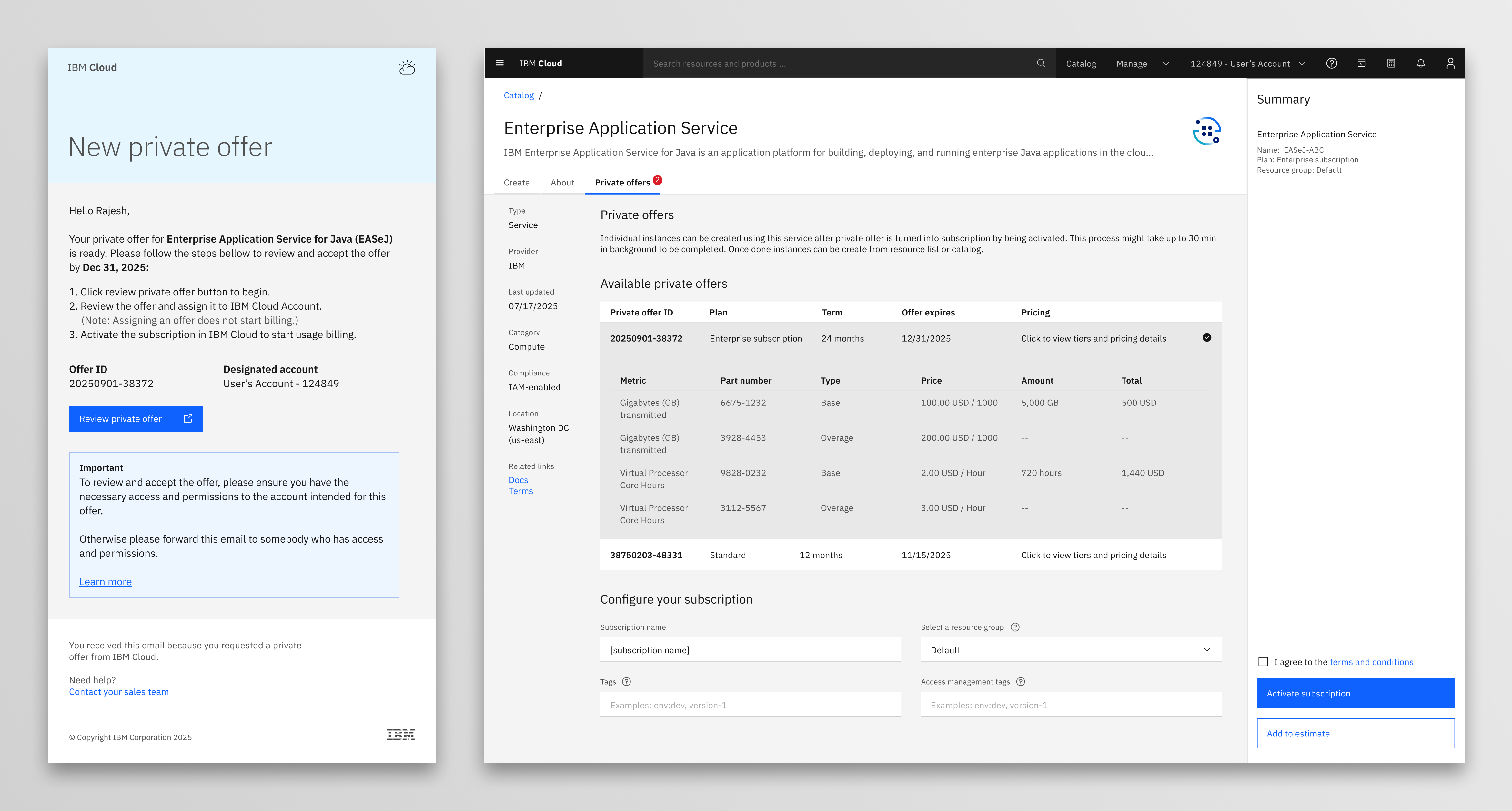
Email and catalog page for accepting and assigning a private offer to an account.
Senior UX Designer, co-leading design
Multi-month engagement (discovery and definition)
2 UX designers, 2 product managers, architects and engineering leads from IBM Cloud and IBM Software, pricing and licensing SMEs, seller and partner stakeholders
As a Senior UX Designer, I helped shape the end-to-end experience for private offers spanning IBM Cloud and IBM Software. I mapped existing workflows, identified gaps and opportunities, facilitated working sessions, and designed system-level flows that aligned multiple teams on a single private-offer model. I partnered closely with PMs, architects, and engineers to define requirements, expose dependencies, and create artifacts that could be used to guide both product strategy and implementation.
IBM Software’s strategy was to sell SaaS subscription entitlements for their products via IBM Cloud—not just as generic cloud spend, but as product-specific commitments that preserved margins and aligned with SaaS seller compensation. On paper, that sounded straightforward. In practice, IBM Cloud only supported a patchwork of ordering paths: pay-as-you-go plans, broad platform subscriptions/credits, or manual entitlements.
IBM needed a quote-to-cash experience for IBM SaaS on IBM Cloud that was at least on par with how software was being sold on other hyperscalers. Pay-as-you-go models didn’t protect profitability or reflect the way SaaS commitments are negotiated. Generic credits hid product-level revenue. Manual entitlements didn’t scale and made even simple operations—like renewals or corrections—painful and risky.
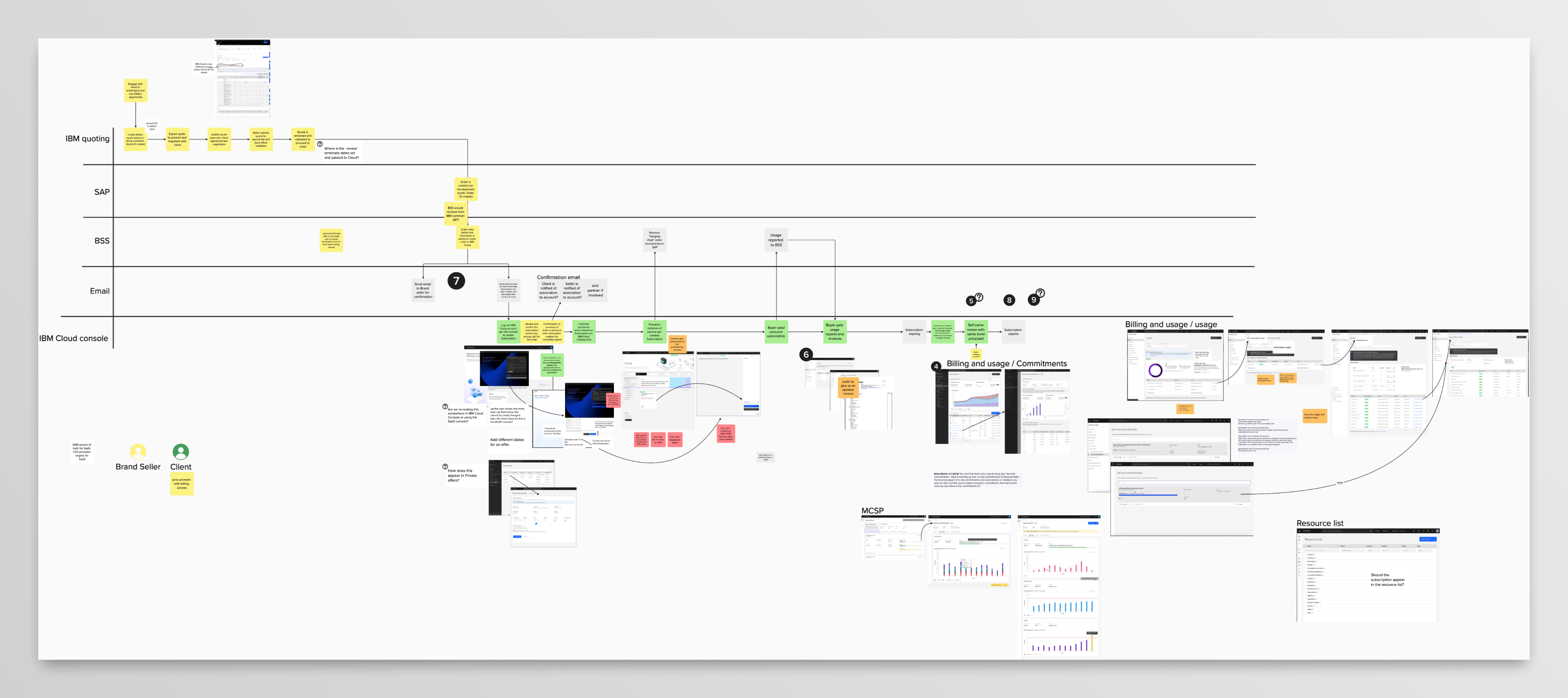
Early sketch of the pre-Skybridge landscape, showing disconnected flows. We used swimlanes to understand the different systems a private offer goes through.
When we started mapping the current-state of the quote-to-cash flow, it became clear we needed to do more than “add a UI” on top.
We had to define a unified subscription model that:
- Preserved software profitability by supporting discrete SaaS commitments instead of relying solely on paygo models
- Incentivized larger customer commits through subscription and overage structures aligned with Software pricing
- Ensured product-level revenue attribution for SaaS subscriptions, not just generic platform spend
- Achieved parity with how IBM SaaS can be ordered on other hyperscalers
- Aligns the ordering model with SaaS seller compensation so that catalog orders would not harm seller incentives
With so many systems, users, and organizations involved, every UX decision carried downstream consequences. A label change in the UI might require a change in a contract template; a new field in a flow might require API behavior to be revisited. The design work had to operate at a system level, not just at the screen level.
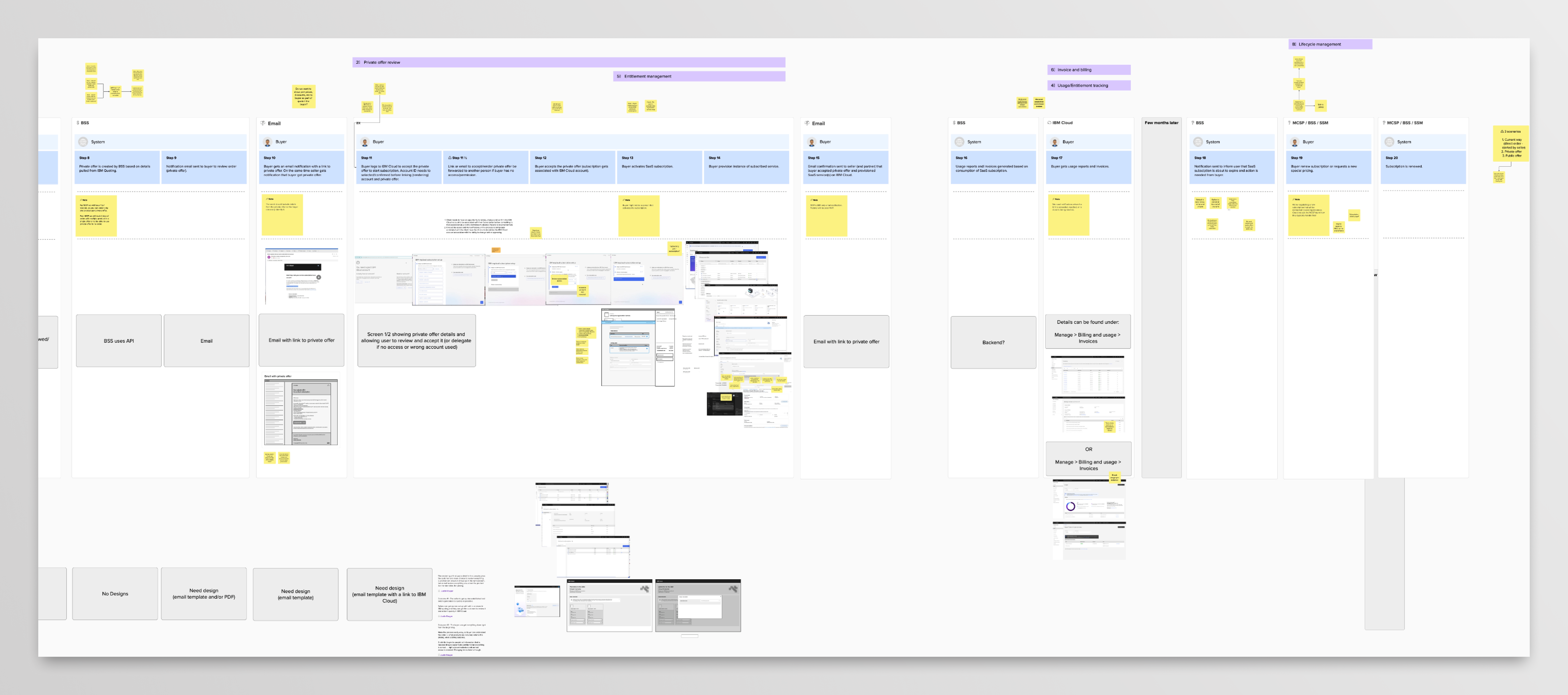
As requirements were nailed down, the sketching began to increase in fidelity. Views like this helped our stakeholders see how the whole system impact's the user's experience.
A big part of my role was creating shared understanding by visualizing the system so everyone—whether from Software, Cloud, billing, or sales—could see how their work fit into the bigger picture. That work showed up in a few key ways:
Regular working sessions
One of the biggest wins of the project was securing daily standing calls with busy senior stakeholders. These weren’t status meetings—they were working sessions. We clarified requirements, surfaced hidden dependencies, and made design and product decisions in real time, instead of waiting weeks for alignment.
Parity with other hyperscalers
Sellers shared a surprising insight: selling IBM Software was often easier on other clouds than on IBM’s own. To understand why, we conducted a comparative analysis of private offer flows from leading hyperscalers and used those findings to set our baseline. If IBM Cloud couldn’t at least match those experiences, we would always be fighting uphill.
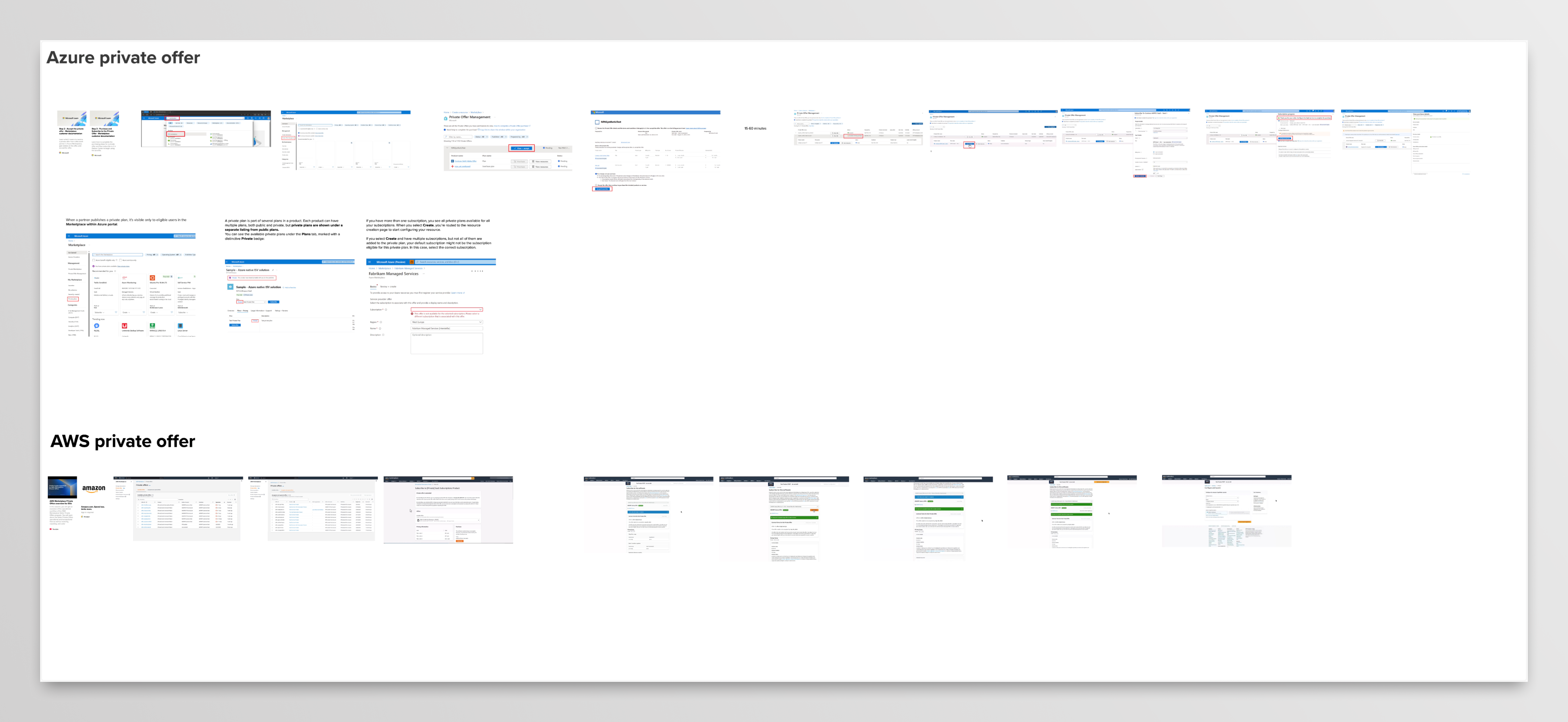
Competitive analysis of private-offer flows from major hyperscalers, used as the baseline for IBM Cloud’s experience.
Understanding technical limitations
The UX we could deliver was tightly coupled to what the underlying systems exposed. We spent time mapping how information moved from quote, to offer, to subscription, to pricing plan—and what data the APIs made available at each step. That understanding was critical when deciding what the UI could responsibly display and when we needed to introduce new states or constraints.

Understanding what information we could access through the API and display in the UI.
Scenario-based UX flows
Once we had the building blocks, we shifted to scenario-based flows: creating a private offer, revising terms mid-contract, bundling multiple products, or handling renewals. These flows became alignment tools as much as design artifacts—they showed, step by step, how systems and users interacted in realistic situations, and gave teams a concrete reference when making tradeoffs.
-
Defined a target quote-to-cash model for IBM SaaS subscriptions on IBM Cloud.
By the end of the engagement, Skybridge had defined a clear target quote-to-cash model for IBM SaaS subscriptions on IBM Cloud. Instead of stitching together paygo, generic credits, and manual workarounds, teams now had a single model for how subscriptions should be ordered, entitled, provisioned, and tracked. -
Aligned Software business needs with Cloud platform capabilities.
The unified workflows made it clear where existing Cloud systems could support Software’s subscription and compensation model, and where new capabilities were needed. Skybridge produced a shared, end-to-end model that both organizations could use—from private offer configuration, through acceptance, to provisioning and usage. -
Demonstrated the value of including design early in complex, systems-level work.
Just as importantly, the work demonstrated how bringing design into complex, systems-level work early can change the trajectory of a project. The flows, diagrams, and scenarios we created weren’t just “deliverables”; they became reference points for architects, PMs, and leaders making strategic decisions.